 |
This week’s selections are again representative of a wide range of biographies. We have two mild-mannered opera-loving sisters who saved dozens of Jews from the Holocaust, a fun autobiography written and drawn by an author and illustrator of children’s books, and a dual biography comparing and contrasting Queen Elizabeth I and her cousin, Mary Queen of Scots.
“We called ourselves Christian and we tried to do our best”
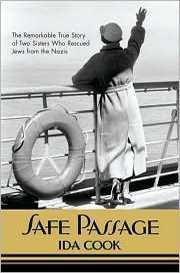
Safe Passage: The Remarkable True Story of Two Sisters Who Rescued Jews from the Nazis by Ida Cook
In the 1930s as Hitler’s Nazi party was gaining power in Germany, neighboring countries were being invaded, and pogroms and concentration camps were cropping up, some people recognized the gathering storm for what it was. British sisters Ida and Louise Cook were some of those people. Ida states in her characteristically self-deprecating way, “To Louise and me, knowledge of the situation had come gradually but inexorably. I make no claim to clearer perceptions than other people. We just happened to be lucky enough to see the problem in terms we could understand. In terms of personal friends, in fact.” In the course of their visits to the European continent to see their favorite opera stars perform, they met and befriended many people, including some endangered by the Nazi regime. They shepherded dozens of these friends, acquaintances and casual contacts through the difficult and convoluted red tape hoops required to gain a British visa and, thus, safety. Describing the process, Ida asserts, “You never know what you can do until you refuse to take no for an answer.”
Ms. Cook’s memoir has a very conversational tone. As I was reading I could just imagine sitting down over lunch with her and listening to her tell her fantastic story. Of course, a conversational tone can include rather abrupt changes in topic or tenor or leaps from light subjects (opera arias) to very dark subjects (ghettos, beatings). For some this might be off-putting (especially if you don’t care for opera), but I felt drawn in by her confidence and her exuberance. When she wrote about the friends she made who were world-famous opera singers and conductors, the operas she’d been able to see, her travels to New York and the European continent for different productions, her passion and enthusiasm for the art practically jumped off the page.
Likewise, she threw herself into her descriptions of the bleakness facing so many Jews during the late 1930s; they were heart-wrenching. But amidst the indescribably inhumane treatment the Jews and others suffered at the hands of the Nazis, there were moments of incredible goodness. Ms. Cook carefully balanced the stories of injustice and terror and fear with lighthearted tales of close escapes and moments of real human kindness so that the horror of the Nazi regime came through, but it wasn’t able to quite overwhelm the reader. Ms. Cook’s optimistic outlook on human nature, despite the evil she saw in Germany, was a constant thread through the book.
I think anyone who has ever read the stories of those, like the Cook sisters, who risked their own lives and freedom to rescue people from the Nazis has wondered if they would have been courageous enough to do the same. Ms. Cook’s memoir gives me hope that yes, perhaps I would have. They saw an opportunity to help those in desperate need and simply did what they could. In doing so, they saved dozens from concentration camps or worse. Even if you don’t care for opera, this is a story not to be missed.
“The perfect indoor hobby”
Bill Peet: An Autobiography
by Bill Peet
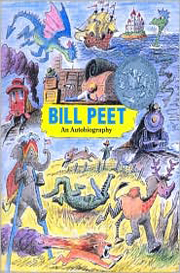 |
Bill Peet is a children’s book author and illustrator (you may know his Cyrus the Unsinkable Sea Serpent, How Droofus the Dragon Lost His Head, or Hubert’s Hair-Raising Adventure), so not surprisingly, his autobiography will look very familiar to those who had the good fortune to read his books in their youth. While the story of his life is interesting, the illustrations-all in Mr. Peet’s distinctive style-are the real reason to pick up this book. Drawing is obviously his first love; every page has at least one sketch and most have many more. The text, while simple and sometimes amusing, just doesn’t hold a candle to the fantastic and fantastical illustrations.
Walt Disney looms large in Bill Peet’s retelling of his own life, sometimes almost more central than Bill Peet himself. It’s an understandable focus since Mr. Peet worked for Mr. Disney’s company for 27 years. His time there included work on many of the best loved animated Disney films as he slowly climbed the ladder from doing fill-in illustrations to overseeing entire full-length features. Bill Peet is the man behind the beautiful depictions of the baby Dumbo (that always make me cry!), Cinderella’s mice, and the sequence in Sleeping Beauty where all the woodland creatures coordinate Aurora and the Prince meeting. He even confesses to basing Merlin in The Sword in the Stone on Walt Disney himself!
Sometimes in autobiographies there is an attempt at self-aggrandizement. Not here. I appreciate Mr. Peet’s humility. He naturally expresses satisfaction in his many successful projects, but he shares several of his less impressive moments as well. At one point he considered a second career as a magazine cartoonist, but he displays a half dozen of his not very funny attempts in the book, acknowledging their lack of brilliance. He also chronicles the day he lost his temper and stormed out of Disney’s Annex hollering “NO MORE DUCKS!” at the top of his lungs only to quickly regret his outburst.
This is a quick read, but with some descriptions of unhappy family life (including a mostly-absent but sometimes abusive father), so a good one to discuss with kids while reading.
“Remarkable women and redoubtable queens”
Elizabeth & Mary: Cousins, Rivals, Queens
By Jane Dunn
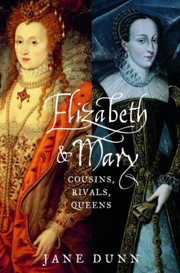 |
Few women have been so alternately criticized, praised, vilified and canonized by subsequent generations as Elizabeth and Mary, oddities in their time as female reigning monarchs when it was considered against nature for women to rule over men. Jane Dunn has written a thorough and balanced account of their relationship and their choices as well as the forces out of their control that directed the course of their lives in ways surprisingly both parallel and divergent.
This book focuses on the time period from 1558 when Mary Queen of Scots married Francois II, Dauphin of France, and Elizabeth ascended the throne of England to Mary’s execution in 1587. Their lives were inseparably intertwined from birth despite the fact that they never actually met face to face. Until reading this book, I had no idea how strong Mary’s claim to the English throne really was – it all hung on the legitimacy (or lack thereof) of Henry VIII’s divorce from his Catholic first wife Catherine of Aragorn. And an individual’s view on that was generally dependent on his or her religious faith. Ms. Dunn provides an impressively coherent and cohesive narrative through a sometimes dizzyingly complex web of politics (both national and international), religion, and personalities.
The contrast Ms. Dunn draws between the two queens is fascinating. Mary was Queen of Scots almost from birth (her father James V died when she was 5 days old) and grew up as a favored member of the French court, groomed from the age of five to marry the Dauphin.
Elizabeth, on the other hand, spent years unsecure in her place in the succession, isolated, threatened, even imprisoned in the Tower of London before claiming the throne at her sister Mary’s death.
Elizabeth was often indecisive and reflective almost to a fault, and her diplomacy made masterful use of feints, delays and equivocation, but she lived every moment with the understanding that “the burden of monarchy was a sacred calling that involved personal sacrifice and solitary duty.” Mary was impatient, passionate in both her loves and hates, more inclined toward action than negotiation, but she “had spent the whole…of her life having abdicated her own authority as queen to a series of men” who did not have her or Scotland’s best interests at heart.
More a comparative analysis than an actual dual biography, Ms. Dunn’s work includes an extremely helpful family tree and chronology of events in the queens’ lives, as well as many color plates with illustrations. It’s a bit long at just over 400 pages, but truly provides fascinating insight into these two remarkable women and the religious and political climate of their time.
**************************
Next column, we’re going to start looking at some books about food: what we eat, why we eat it, what might be better, and what grandma has to say about it.
Any final thoughts on biographies or memoirs? What great books about food or eating have you read? What’s currently on your reading list? Suggestions, comments, and feedback welcome at [email protected]“>[email protected].